DMA moves to curb hunger in Leribe
SHARE THIS PAGE!
Families in Leribe are grappling with daily hunger, surviving on occasional piece jobs, help from neighbours and, in some cases, the resilience of children left to fend for themselves.
In several villages across the district, poverty has pushed households into desperate situations. Some parents have abandoned their children, spending nights in taverns and leaving the young ones to beg for food from neighbours.
In other homes, parents live with disabilities and cannot support themselves, while those able to work say employment opportunities are scarce.
Forty-year-old Matlhokomelo Mafa of Ha Sekeleme in Matlameng supports a family of six, including four children. She recalls a public gathering (pitso) where officers from the Disaster Management Authority (DMA) asked villagers about their most urgent household needs.
“They asked us how we survive on a day-to-day basis. At that time, we had no food at all,” Mafa said.
She explained that her family survives on piece jobs such as harvesting, picking berries or washing clothes, but such work is irregular. Relief came on December 17, 2025, when her household received a food parcel from the DMA.
Mathabang Selebeli (51) of Ha Ntšeli, Malibamatšo, shares a similar story. Her family received food assistance on December 14, 2025, when they were in dire need.
“Because of drought, there is no ploughing and our animals are dying. Drought has affected many families badly in this area, and everyone is trying any means possible to survive,” Selebeli told theReporter in a telephone interview last week.
She said her family previously benefited from a road-maintenance project that paid M500, but the work has since stopped, cutting off a vital source of income.
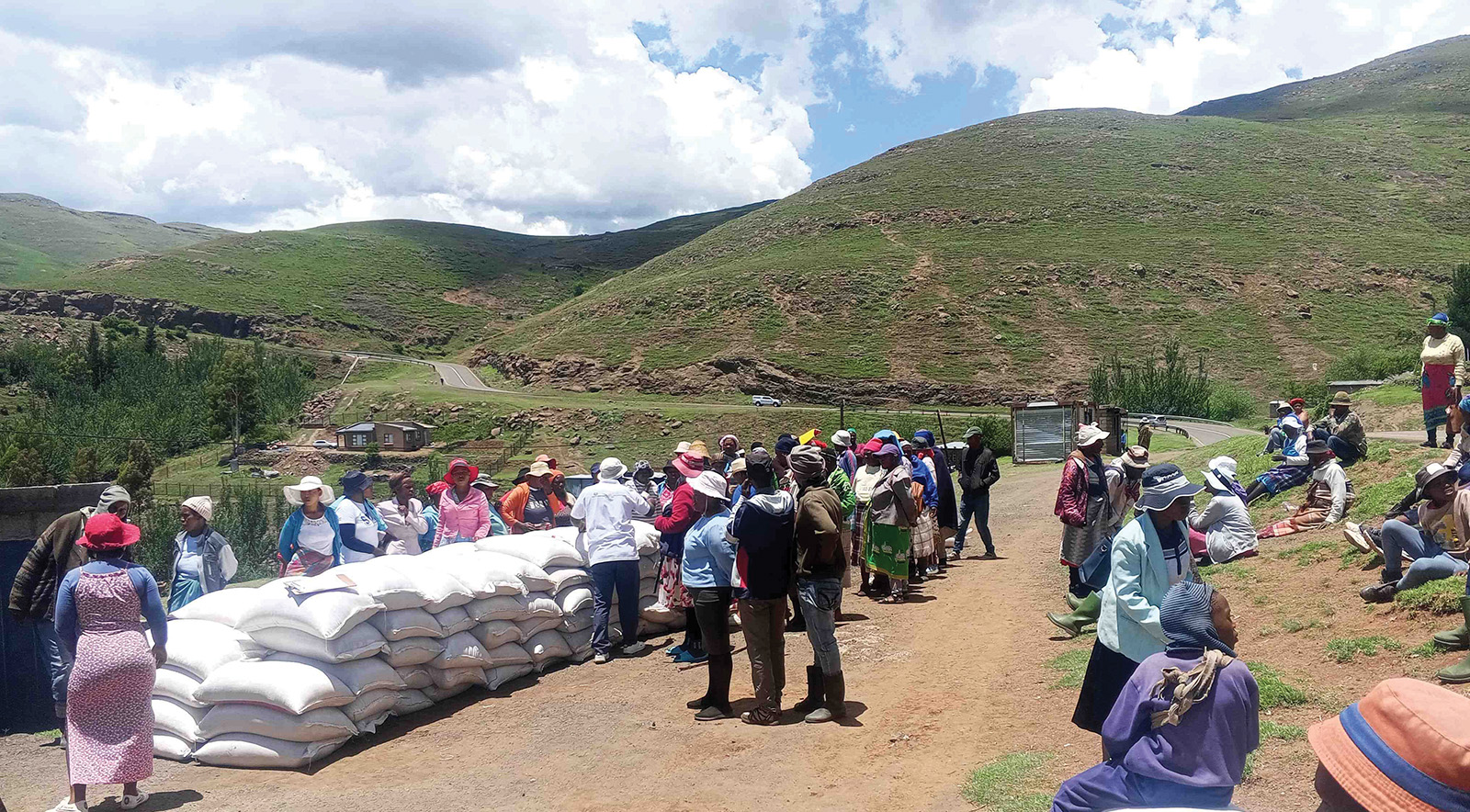
The Mafa and Selebeli households are among 10,679 vulnerable families targeted for food distribution across Leribe’s seven community councils. The programme is administered by the DMA through the District Disaster Management Team (DDMT).
Acting District Disaster Manager, Mare Keketsi, said the distribution, which covers the Matsoku, Ramapepe, Bolahla, Maoamafubelu, Sephookong, Maisaphoka and Menkhoaneng community councils, includes maize, sorghum, wheat and beans.
Keketsi explained that eneficiaries are selected based on the Lesotho Vulnerability Assessment, which identifies households at risk of poverty, particularly where farming has failed.
“The assistance targets vulnerable households and is not meant for everyone,” he noted.
Food distribution resumed on January 5, 2026, after a temporary halt during the 2025 Christmas holidays.
The DMA’s 2025 Vulnerability Assessment and Analysis paints a grim picture of food security in Lesotho. It says although national crop estimates show an increase in land planted for maize, sorghum and wheat, yields per hectare declined compared to the 2023/24 season due to severe drought.
Maize production dropped by 19 percent —from 56,472 metric tonnes in 2024 to an estimated 45,780 metric tonnes in 2025. Sorghum production fell by 43 percent, while wheat production increased by 17 percent. Despite these shifts, Lesotho is expected to meet its cereal requirements through imports from South Africa, where maize production has improved.
Rising living costs continue to strain households. The Survival Minimum Expenditure Basket increased from M1,220 to M1,320 per month for a family of four in 2025.
The Food Consumption Score also worsened, with 25 percent of households recording poor consumption, up from 19 percent in 2024.
The Lesotho Vulnerability Assessment Committee (LVAC) — a government-led, multi-disciplinary body under the DMA — conducted the 2025 assessment to inform evidence-based policies and programmes to improve food and nutrition security.
Established in 2002, LVAC comprises government ministries and departments, UN agencies, non-governmental organisations and the private sector.
While the assessment process remains largely centralised, it is at an advanced stage of decentralisation, with district teams now responsible for data collection and contributing to analysis and report writing.
Meanwhile, the United Nations World Food Programme (WFP) has warned that urgent funding is needed to support thousands of food-insecure people in Lesotho during the 2025/2026 season.
In its latest Lesotho Country Brief, WFP said it requires US$5.9 million (M98.9 million) to assist 48,000 food-insecure people between November 2025 and March 2026, but no donor funding has been pledged to date.
At the same time, WFP is scaling up early recovery initiatives to strengthen livelihoods and reduce reliance on humanitarian aid. In Qacha’s Nek, the agency is implementing targeted livelihood and skills training, reaching more than 2,000 people who received food assistance during the 2024/2025 lean season. During the period, 108 farmers from Sehlabathebe and Qhoalinyane Resource Centres were trained in climate-smart livestock practices and improved crop management.
“Building resilience at community level is critical in a context where climate shocks are becoming more frequent and severe,” WFP said.
To reinforce the training, WFP has procured non-food items — including vegetable seeds, sewing machines, solar driers and hermetic storage bags — to support income generation and food preservation. The agency also continues to support Lesotho in strengthening anticipatory action and disaster preparedness.
In November 2025, WFP facilitated the participation of the DMA and Lesotho Meteorological Services in the Southern African Anticipatory Action After-Action Review Workshop in Antananarivo, Madagascar, aimed at strengthening regional coordination and drawing lessons from a decade of anticipatory action programming.
DMA moves to curb hunger in Leribe
5 days ago
Vodacom Lesotho empowers youth to purse STEM
5 days ago
Lesotho confident of AGOA extension
5 days ago

Agency to host fashion week
5 days ago


Ha Pita women found guilty of assault
8 days ago